Setup: only two PCs on a LAN
The two PCs are wired to the same LAN (1 Gb/s). No internet cloud is used. Both are the machines from the Strata research and physical AI pages. Video takes the longest, so the cuts are split across the two GPUs and made at the same time.
| PC | CPU | RAM | GPU | Runs |
|---|---|---|---|---|
| PC 1 (decisions and finishing) | Core i7-7800X (6 cores, AVX-512) | 125 GiB | RTX 5060 Ti 16 GB | Strata (planning, review, fix plans, choosing takes), Qwen-Image (images), MiniMax-H3 (video, 3 cuts), VOICEVOX (CPU), ffmpeg, the record database |
| PC 2 (video) | Xeon E5-2630 v2 × 2 (AVX only, 2013 generation) | 251 GiB | RTX 3060 12 GB | MiniMax-H3 (video, 2 cuts), with stable-diffusion.cpp rebuilt for an AVX-only CPU |
- Strata and the video model cannot share a GPU at the same time. Strata nearly fills PC 1’s 16 GB GPU, so it is stopped while images and video are made (3 s) and restarted afterwards (about 1.5 min).
- The same video model also runs on PC 2’s RTX 3060. One cut (about 3 s) takes about 400 s on PC 1 and about 575 s on PC 2. Splitting the cuts brings five cuts down to about 20 min (about 33 min on PC 1 alone).
Tools: the AI that decides is separate from the AIs that make
| Tool | Role | Settings / time |
|---|---|---|
| Strata 0.2.15 + Qwen3.8-Flash-Next (NVFP4) | Planning and shot list, reviewing the finished video (reads images), fix plans, choosing takes; all with thinking | plan 195 s, review 4–12 min, fix plan 6–10 min |
| Qwen-Image 2.1 Turbo (Q8_0) | The first frame of each cut and reference pictures of people and products; can draw while looking at reference pictures | 8 steps, 832×480, 15–22 s per image |
| MiniMax-H3 (ref2va pruned Q4_K_M, stable-diffusion.cpp) | Makes about 3 s of video plus matching sound effects from the first frame | 73 frames (24 fps), 20 steps. PC 1 about 400 s, 15.2 GB peak; PC 2 about 575 s, 11.3 GB |
| VOICEVOX 0.26.1 (CPU) | Narration per cut (speaker No.7, announcer style) | about 3 s for five lines |
| ffmpeg・Pillow | Joining cuts, captions, mixing sound effects and narration | a few seconds |
| SQLite | Storyboard database: shared elements (people, products), versions of each cut, review findings, fix plans, timings | — |
DeepSeek (V4.1 Flash) also runs on Strata, but it is text-only and cannot read images, so it was not used for reviewing the video.
Roles: Strata decides, the tools make, fixed rules connect them
A person only gives the brief and does not step in afterwards. Strata answers in JSON, and fixed code passes it straight to the tools.
- StrataPlan and shot list — A fictional brand, selling point and catchphrase; for five 3-second cuts, the image, motion and sound instructions (English) plus narration and captions (Japanese).
- Qwen-ImageFirst frames — One per cut.
- MiniMax-H3Video and sound effects — Split across the two PCs, at the same time.
- VOICEVOXNarration — On the CPU while the video is made.
- Fixed codeFinishing — Trim each cut to 3.0 s, join, add captions, mix narration over the sound effects.
- StrataReview — Looks at three frames per cut (start, middle, end) and the plan, and lists problems, severity and how to fix them.
- StrataFix plan — Registers shared elements (people, products), decides keep/redo per cut with new instructions, picks the caption style, and declares what cannot be fixed.
- StrataChoosing takes — From every version kept in the database, picks the best take for each cut and assembles them.
The first ad: done in about 25 min, but with problems such as an empty bottle and a different boy
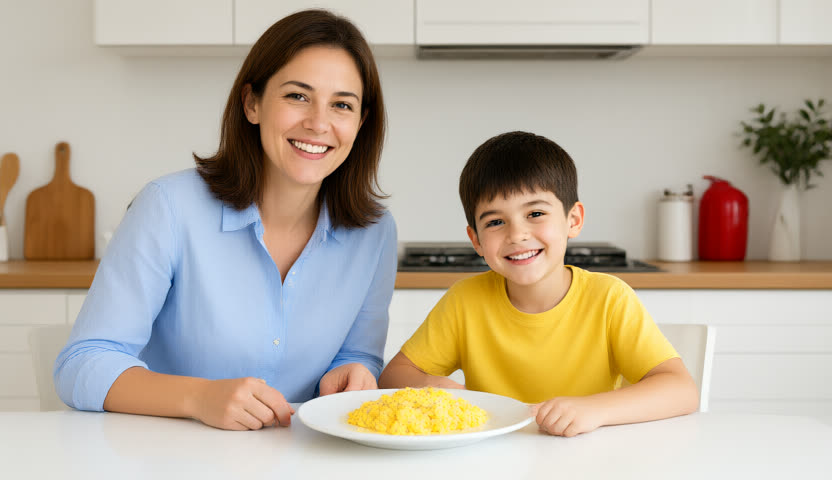
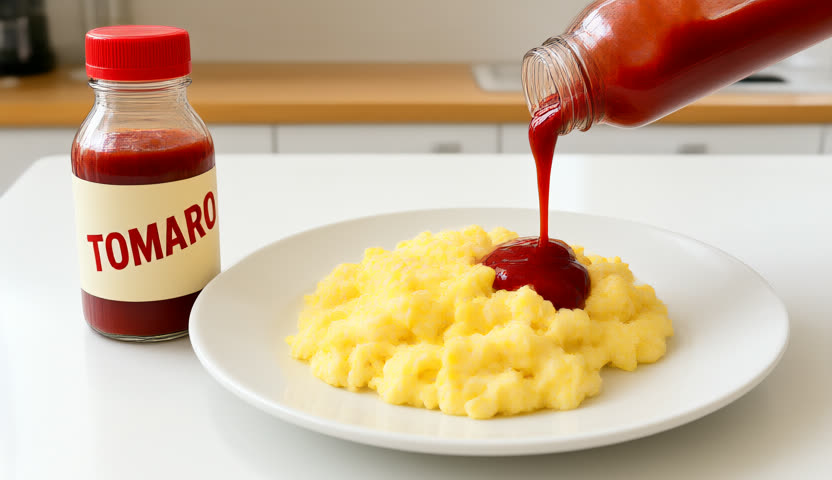
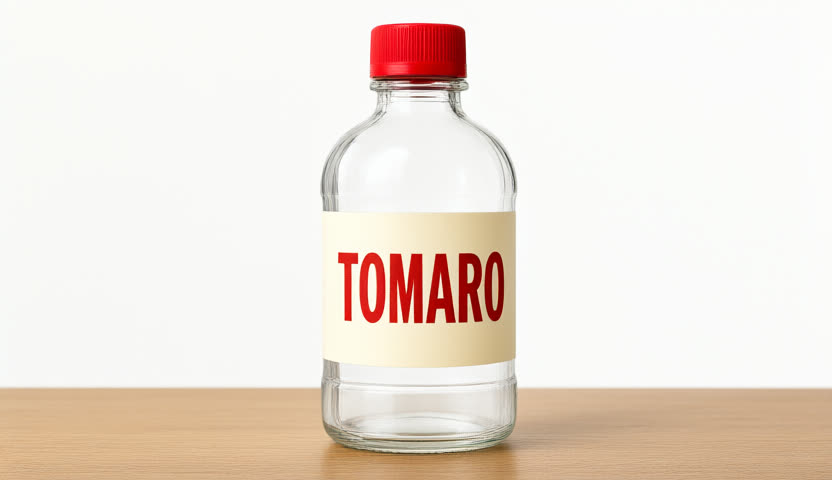
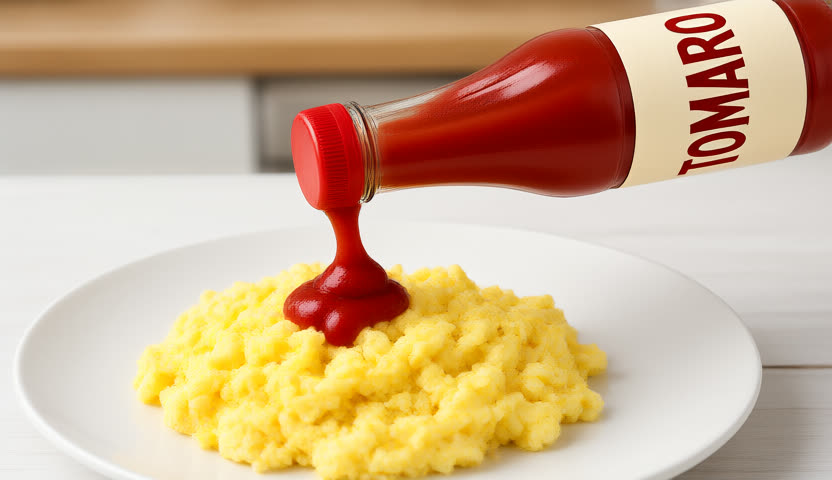
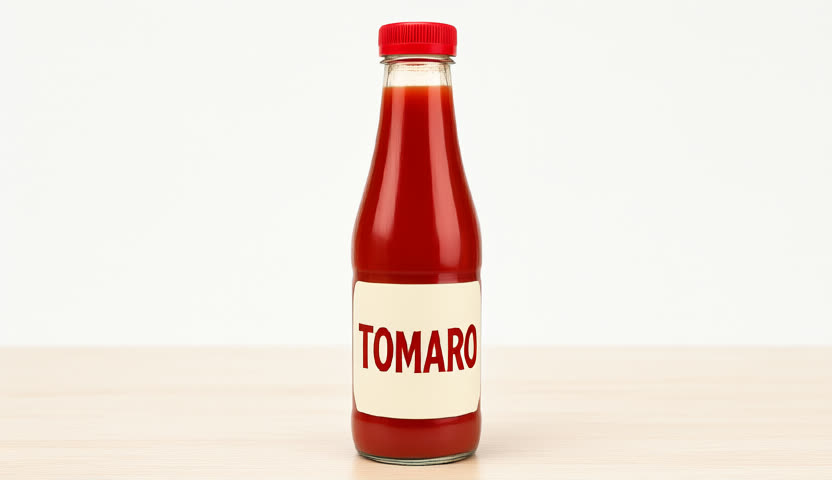
The brief: “a typical modern 15-second ketchup ad, for a fictional product”. Strata invented “TOMARO Sweet-and-Rich Ketchup” (catchphrase “sweet and rich, nice and thick”, aimed at parents who want brighter family meals) and five cuts: family table → pouring on scrambled eggs → ripe tomato → the boy eats → product shot. Below are the first frames of each cut (Qwen-Image).


| Step | Tool | Time |
|---|---|---|
| Plan and shot list | Strata | 194.7 s |
| Five first frames | Qwen-Image | 81.9 s |
| Video, five cuts (two PCs in parallel) | MiniMax-H3 | 19.9 min |
| Five narration lines (parallel to video) | VOICEVOX | 6 s |
| Finishing | ffmpeg | 1.4 s |
| Total (wall clock) | about 25 min |
- Cuts 1–4 looked like a live-action ad. The ketchup pours thickly and the TOMARO label stays intact. The video model made sound effects matching the picture, and the narration read the brand words correctly.
- Problems: the product shot shows an empty bottle (the plan never said it was filled), hands that were not in the picture appear in the product shot (added by the video model), the boy in cuts 1 and 4 is a different child, the captions are thin, and there is no music.
Review by Qwen: it found the big problems by itself, even without a checklist
We showed Strata three frames per cut (15 images) from the finished ad plus the plan, and asked it to point out problems, without telling it the answers. A had no checklist; B had eight generic checks that fit any ad (product look, consistency of people, things not in the instructions, broken shapes, motion, text, sound and structure, the ad as a whole).
| Problem (found by a person) | A: no checklist | B: generic checks |
|---|---|---|
| The boy differs between cuts 1 and 4 | ◎ major | ◎ major |
| The product bottle is empty | ◎ major | ◎ major |
| Hands appear in the product shot | ○ medium | ◎ major (and the broken fingers) |
| Captions | △ inconsistent style | ○ unreadable against the background |
| No music | × | × |
| Time | 611 s | 238 s |
- It also found problems the person had missed: two bottles in cut 2 (already in the first frame), a wood table instead of the planned white one in the product shot, the boy not smiling after the bite, water running as a streak instead of one drop, basil-like leaves under the tomato, a second spoon appearing, and more.
- With the checklist it was faster (4 min) and also caught broken hands, fingers and small objects. The checks are generic, not written for this ad.
- Sound is a weak spot. Qwen cannot hear audio, and even with “no music” in the plan it did not at first notice that an ad needs some (it raised this only in the second review).
- Each finding comes with a fix: which step to change (plan, image, motion, sound, captions) and a rewritten English instruction. These were used for the self-fixing below.
Self-fixing: shared reference pictures removed the big problems; picking from all takes gave the best result
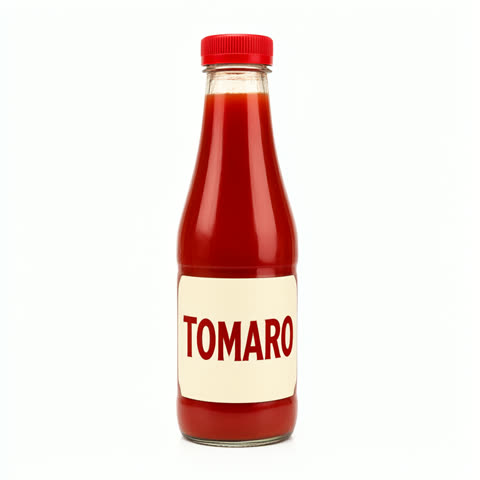
We added a storyboard database (SQLite) and kept people and products that appear in several cuts as “shared elements”: a description plus a reference picture, stored once. Strata reads the review findings and writes a fix plan, code remakes the cuts accordingly, and Strata reviews again. Every version of every cut, the finding behind it and the fix are kept.




| Round | What Strata did | Major | Medium | Minor | Time |
|---|---|---|---|---|---|
| 0 | First ad | 4 | 5 | 2 | ~25 min |
| 1 | Registered the boy, mother and bottle as shared elements, remade 4 cuts, bold captions on a band | 1 | 6 | 3 | ~44 min |
| 2 | Remade all 5 cuts, outlined captions; declared “no tool to add background music” as unfixable | 2 | 4 | 3 | ~44 min |
| 3 | No remaking: picked the best of all 14 takes in the database for each cut | 1 | 3 | 4 | ~19 min |
- Round 1 fixed three of the four major problems structurally. The boy is drawn from the same reference in cuts 1 and 4, so the face matches; the bottle reference is filled; “no hands” in the product shot removed the hands; the captions became bold.
- Remaking mixes fixes with new problems. In round 2 the boy wore a red T-shirt and the product shot gained wood and books. The cause was not Strata but the assembly rules: code appended the plan’s style words (“warm wood surfaces, vivid red accents”) to every instruction, so Strata’s “no wood” was overridden.
- Picking from all takes was the cheapest and the best. Asked to judge with its own eyes rather than trust the review, and to keep the cuts consistent, Strata dropped the red-T-shirt take because it “breaks continuity with cut 1”, and listed ten remaining problems itself.
- Weak points: it accepted a wrong finding as is (in round 1 it changed the narration to follow a mistaken “catchphrase word order is reversed”), and the severity it gives the same footage varies between reviews (the same take was “medium” once and “major” once).
Big problems, even without a checklist
Including several a person missed. It cannot hear audio.
Shared references aligned people and products
Music, with no tool for it, was declared unfixable.
Choosing the best of all takes worked best
About 19 min with no remaking, possible because every take is kept.
The videos were made with MiniMax-H3, whose MiniMax H3 Community License excludes the EU, the UK, the Republic of Korea and the USA and does not allow outputs to be displayed there. Because this page can be viewed worldwide, the videos and frames from them are not shown. Every picture on this page was drawn by Qwen-Image 2.1 (Apache-2.0).
All pictures, products, people and the brand on this page are fictional and machine-generated. Narration voice: VOICEVOX:No.7.